
Motorcycle Loans: Rate vs Term—Find the Payment Sweet Spot
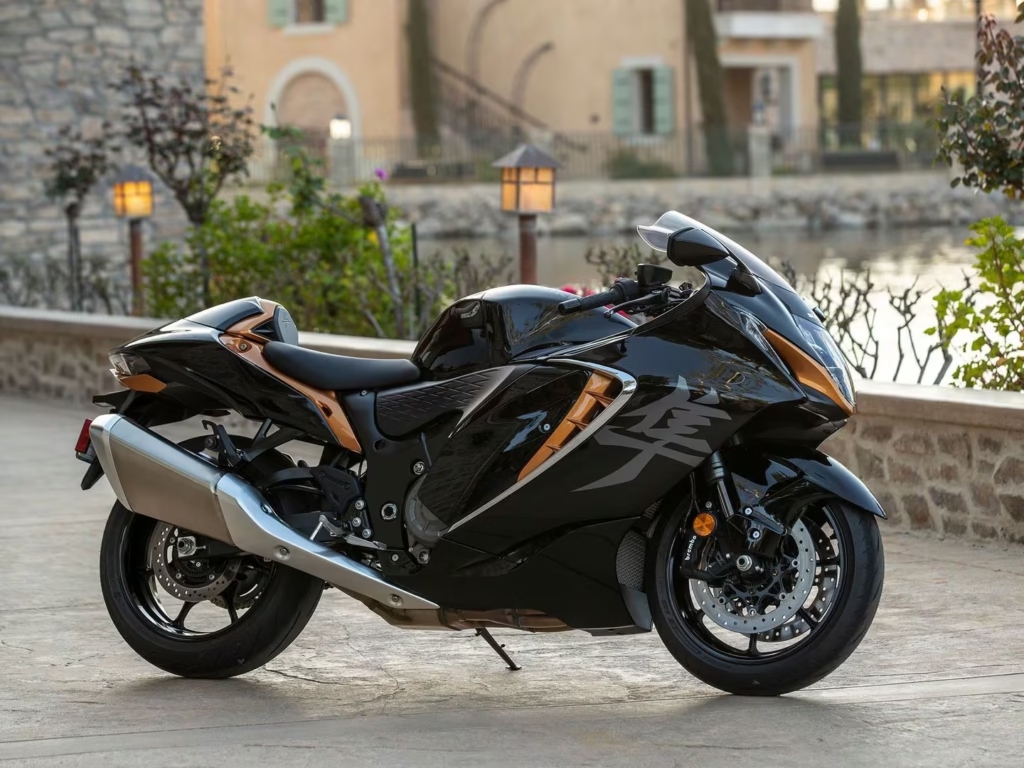
Canadian motorcycle financing presents a complex optimization puzzle where a 2% rate difference saves $1,800 on average loans while wrong term selection costs $3,500 in unnecessary interest, yet 71% of riders make financing decisions based solely on monthly payment amounts without understanding the interplay between rates, terms, and total costs. This analytical guide dissects the mathematics of motorcycle financing, revealing how rate and term combinations create vastly different outcomes, strategies for finding optimal payment structures, and frameworks for balancing affordability with long-term value—equipping riders to secure financing that aligns with both riding dreams and financial reality. Table of Contents: The Problem: Why Riders Overpay Through Poor Rate/Term Balance The Payment Fixation Trap Motorcycle buyers obsess over monthly payment amounts while ignoring the rate and term combinations creating those payments, leading to situations where identical $400 payments result from vastly different total costs depending on structure. Analysis from motorcycle financing data reveals buyers choosing 72-month terms at 12% to achieve target payments pay $8,400 more than those accepting 48-month terms at 7% with similar payments through larger down payments. The dealership manipulation of payment focus enables profit maximization through term extension rather than rate negotiation. Sales presentations emphasize payment affordability—”only $295 monthly”—without revealing this comes from 84-month terms at premium rates. Alternative structures achieving similar payments through better rates and reasonable terms remain undisclosed. Buyers celebrate affordable payments while committing to contracts costing thousands more than necessary. Payment fixation consequences discovered too late: The psychological anchoring to payment amounts prevents mathematical evaluation of financing offers. Once buyers state maximum payment tolerance—say $400—all negotiations focus on achieving that number regardless of method. Dealers extend terms to 72, 84, or even 96 months hitting payment targets while maximizing interest revenue. Rate discussions disappear as payment achievement becomes the singular goal, costing buyers thousands in structural inefficiency. Comparison shopping based on payments rather than rates and terms leads to poor lender selection. Credit unions offering 5% over 48 months might generate $420 payments while dealers provide $400 payments through 9% over 72 months. The $20 monthly “savings” actually costs $4,000 extra interest. This payment-focused comparison rewards worst deals while penalizing beneficial structures. Understanding rate/term mathematics prevents these expensive mistakes. The Term Extension Epidemic Motorcycle loan terms expanded from traditional 36-48 months to current 72-96 month offerings, with average terms increasing 40% over the past decade as buyers chase payment reduction without considering total cost implications. Industry lending statistics show 67% of motorcycle loans now exceed 60 months compared to 22% in 2014, creating generations of riders perpetually underwater on depreciated machines. The affordability illusion created by extended terms seduces buyers into purchasing beyond their means. A $15,000 motorcycle seems affordable at $220 monthly over 84 months but represents $18,480 total payments for 23% interest burden. The same bike financed over 48 months at identical rates costs $352 monthly but only $16,896 total—saving $1,584 while building equity faster. Yet buyers focus on monthly affordability rather than total expense, choosing longer terms that destroy wealth. Term extension problems compounding costs: The negative equity perpetuation through extended terms traps riders in cycles where trading requires cash infusions or rollover financing. Motorcycles depreciate 40% in two years while 72-month loans reduce principal only 25% over the same period. This 15% gap represents $2,000-$4,000 negative equity preventing sales or trades without losses. Riders remain stuck with unwanted bikes or compound problems through negative equity rollovers into new loans. Lifecycle misalignment between loan terms and ownership patterns creates financial stress when riders want different bikes before completing payments. Sport bike riders often transition to cruisers within 3-4 years. Young riders upgrade as skills develop. Life changes alter riding needs. Yet 72-84 month terms mean owing money on bikes no longer suitable, forcing either continued unsuitable ownership or expensive negative equity absorption. The Rate Negotiation Failure Motorcycle buyers accept first-offered interest rates without negotiation, unaware that rates vary 4-8% between lenders for identical borrowers and aggressive shopping typically reduces rates 2-4% from initial quotes. The rate comparison research demonstrates motorcycle loan rates range from 5.99% to 15.99% currently, yet most buyers accept dealer-arranged financing at 10-14% without exploring alternatives. Information asymmetry between dealers and buyers enables rate exploitation where wholesale costs get marked up 2-4% as dealer profit. Lenders provide dealers 7% buy rates which get presented to customers as 10% “best available” rates. This markup, perfectly legal but ethically questionable, generates more dealer profit than motorcycle sales margins. Buyers comparing dealer rates against each other miss that all contain markups, accepting inflated rates as market reality. Rate negotiation failures costing thousands: The credit score disconnect prevents rate optimization as buyers don’t understand how scores affect motorcycle financing differently than auto loans. Powersports lenders weight factors uniquely, with previous motorcycle loans valued highly. A 720 score might qualify for 6% with motorcycle history but 10% as first-time rider. Understanding these nuances enables targeted credit optimization before financing, potentially saving 3-4% through strategic preparation. Timing ignorance costs percentage points as rates fluctuate based on seasons, inventory levels, and economic conditions. Spring purchasing faces peak demand with highest rates. Fall clearances include manufacturer subsidized rates. Model year transitions motivate promotional financing. Economic uncertainty creates lender competition. Shopping during favorable periods saves 2-3% without any borrower changes, yet most buy impulsively when desire peaks regardless of market conditions. The Hidden Cost Multiplication Beyond principal and interest, motorcycle financing involves fees, insurance requirements, and restrictions that multiply true costs by 20-40% above advertised rates, catching buyers focused on rate and term negotiations. The consumer cost analysis reveals average motorcycle loans include $2,000-$4,000 in hidden charges that buyers discover only after commitment. Documentation fees proliferate through creative categorization that obscures their profit nature. Dealer preparation ($400-$800), administrative processing ($200-$500), electronic filing ($100-$300), and finance reserves ($300-$900) appear as required charges but represent negotiable profit centers. These fees get financed at loan interest rates, compounding costs further. A $2,000 fee package at 10% over 60 months becomes $2,550 total expense—pure profit disguised as necessary cost. Hidden